ANTONIO RAIMO GALLERY
“Bathsheba Bathing” by Raphael
“Bathsheba Bathing” by Raphael
Couldn't load pickup availability
“Bathsheba Bathing” by Raphael
c.1742
Engraving
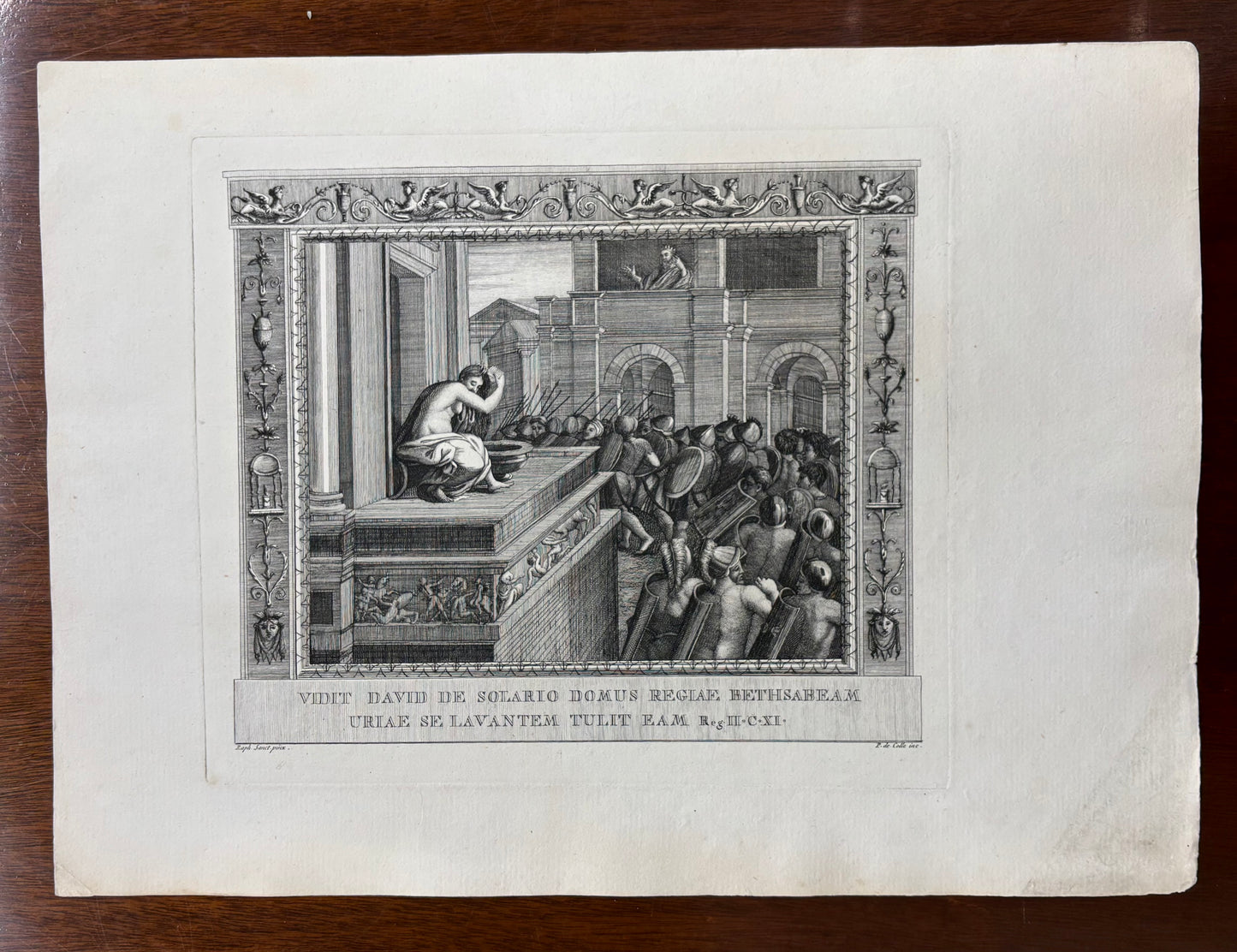
A partially nude Bathsheba bathing on an elevated terrace anchors the left register of this 18th-century black-and-white copperplate engraving. The print visualizes the intense Old Testament narrative of temptation and moral conflict, capturing the exact moment King David looks down from a high palace balcony to spy on the washing figure. Bathsheba adjusts her hair beside a heavy stone basin under a classical colonnade, while a massive phalanx of armored soldiers carrying helmets, spears, and large shields marches through the courtyard below, symbolizing the impending military fate of her husband, Uriah the Hittite. A highly decorative frame borders the entire composition, filled along the top with symmetrical grotteschi elements such as winged griffins and swirling vines. The Latin inscription along the lower margin references 2 Samuel 11, reading "VIDIT DAVID DE SOLARIO DOMUS REGIAE BETHSABEAM URIAE SE LAVANTEM TULIT EAM. Reg. II. C. XI." The lower margins attribute the original design to the High Renaissance master Raphael on the left ("Raph. Sanct. pinx.") and the plate engraving to the Italian printmaker Francesco de Grado on the right ("F. de Grado inc.").
This engraving reflects the profound 18th-century European fascination with classical antiquity and the visual reconstruction of ancient literary figures. Created during a period when aristocratic collectors and scholars eagerly built expansive libraries of historical prints, this work showcases the sophisticated collaborative printmaking networks of Italy. Artists like Francesco de Grado specialized in translating classical narratives into accessible, highly detailed two-dimensional portraits that blended historical armor studies with allegorical landscapes. Prints like this hold significant historical importance because they served a dual purpose, functioning both as high-status decorative art for grand European estates and as vital academic reference tools used by Enlightenment-era scholars to study classical mythology, literature, and design.
Dimensions: H 13” x 17 ½” W
Condition: Minor handling smudges concentrated at the right corner.