ANTONIO RAIMO GALLERY
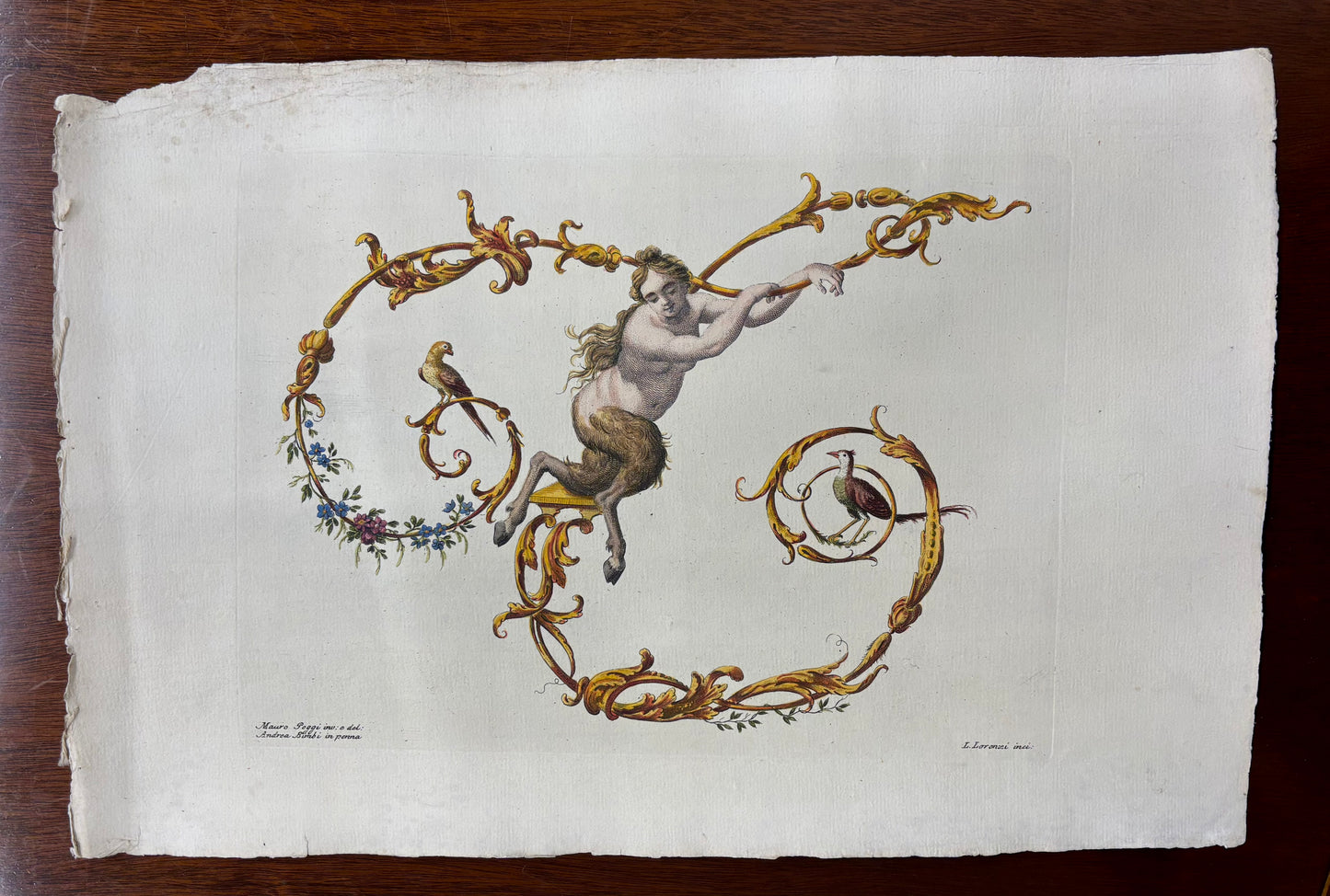
“C” by Mauro Poggi
“C” by Mauro Poggi
Couldn't load pickup availability
“C” by Mauro Poggi
c.1730
Hand-painted Engraving
A spectacular hand-painted print from Mauro Poggi’s legendary Alfabeto di lettere iniziali masterfully transforms the letter C into a whimsical theater of Rococo fantasy. Originally conceptualized by the Florentine scribe Mauro Poggi and brought to life by the engraver Abbé Lorenzo Lorenzi around 1730, the expansive initial is sculpted from twisting, golden acanthus vines. The open, flowing design of the letterform elegantly anchors a theatrical arrangement of mythological and natural figures: a central female centaur strides along the interior architecture, a small songbird perches gracefully over a delicate garland of blue and purple wildflowers on the left, and a long-tailed wading bird nests within the swirling volute on the right. Soft, hand-applied watercolor washes imbue the metallic foliage with architectural weight while casting a lifelike luster over the biological elements, showcasing an ideal harmony between typographic anatomy and decorative illustration. Serving both as a rare graphic specimen and a triumph of imaginative book art, the plate captures the absolute height of mid-eighteenth-century ornamental engraving.
Poggi's Alfabeto di lettere iniziali is widely regarded as one of the finest and most imaginative alphabet books of the eighteenth century. Comprising twenty-four engraved initials, each letter is animated by an inventive cast of animals, mythological creatures, and human figures integrated seamlessly into sweeping Rococo forms. Although little is known about either Poggi or his engraver, Lorenzo Lorenzi, this remarkable publication secured Poggi's lasting reputation among historians of lettering and book arts. Bibliographer Bonacini described it as a "precious collection of astonishing imaginative richness," while H. Lehman Haupt, in his influential 1958 essay Human Alphabets, praised Poggi's ability to achieve "monumentality" through the graceful integration of countless decorative details into unified compositions. Extremely scarce, with only a handful of institutional copies recorded, the work represents a high point in the history of ornamental alphabets and reflects the eighteenth century's fascination with the union of calligraphy, printmaking, and decorative art.
Dimensions: H 11 ½”x 17 ½”W
Condition: Small, barely visible spots on the upper left