ANTONIO RAIMO GALLERY
“Isaac and Rebecca” by Raphael
“Isaac and Rebecca” by Raphael
Couldn't load pickup availability
“Isaac and Rebecca” by Raphael
c.1742
Engraving
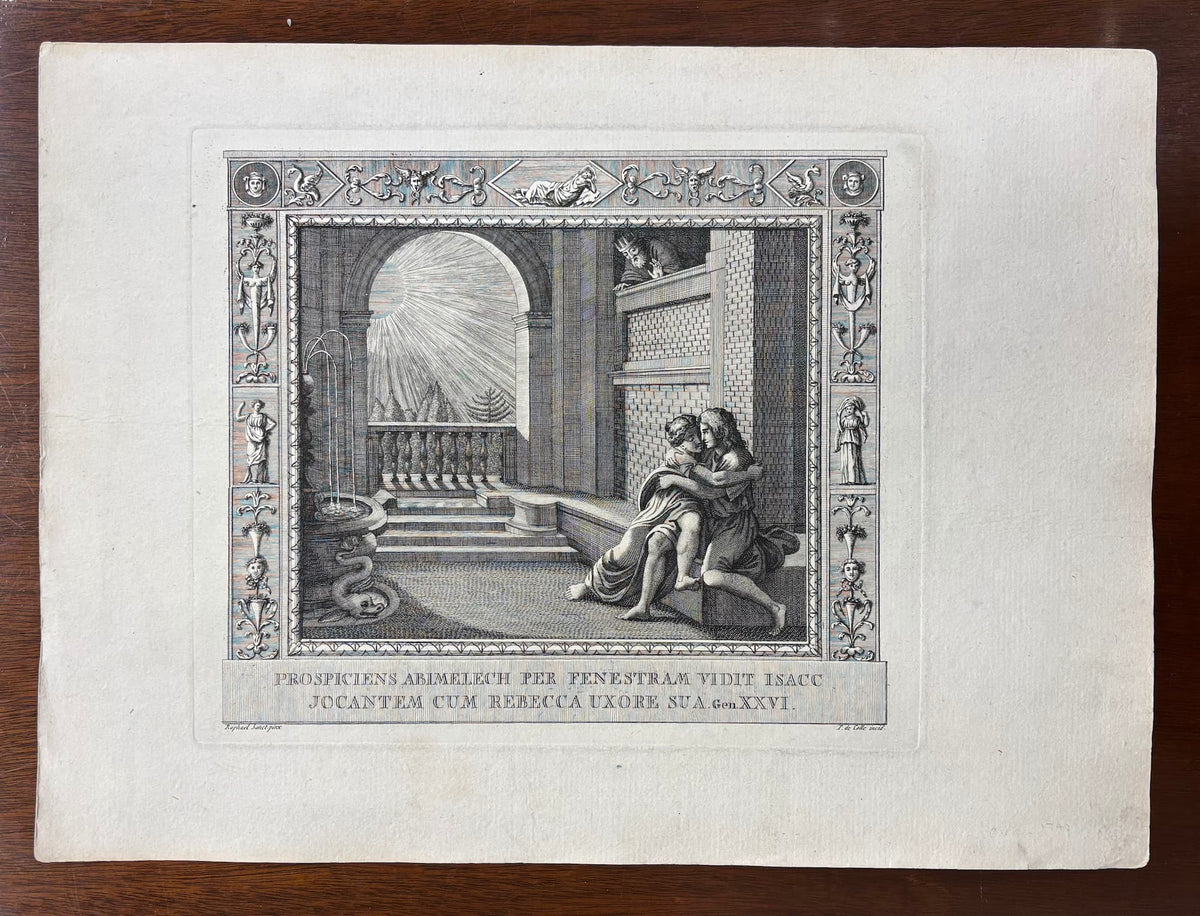
The biblical narrative from Genesis 26 comes to life in this 18th-century black-and-white copperplate engraving titled "Isaac and Rebekah," which showcases an intimate embrace between the couple in the lower right register [metmuseum.org]. Replicating a celebrated composition designed by the High Renaissance master Raphael, the scene visualizes the exact moment King Abimelech looks down secretly from an upper window to discover their true relationship [metmuseum.org]. The figures sit caressing each other within an ornate palace courtyard, which features a spouting tiered fountain wrapped in a stone serpent on the left and a balustrade terrace that opens up to a garden under a radiating, sunburst sky. A highly decorative frame borders the entire composition, filled with complex grotteschielements such as winged sphinxes, classical portrait medallions, and stylized floral urns. The Latin inscription along the lower margin reads "PROSPICIENS ABIMELECH PER FENESTRAM VIDIT ISAAC JOCANTEM CUM REBECCA UXORE SUA Gen. XXVI." The lower margins attribute the original design to Raphael on the left ("Raphael Sanct. pinx.") and the plate engraving to the Italian printmaker Francesco de Grado on the right ("F. de Grado incid.").
This engraving reflects the profound 18th-century European fascination with classical antiquity and the visual reconstruction of ancient literary figures. Created during a period when aristocratic collectors and scholars eagerly built expansive libraries of historical prints, this work showcases the sophisticated collaborative printmaking networks of Italy. Artists like Francesco de Grado specialized in translating classical narratives into accessible, highly detailed two-dimensional portraits that blended historical armor studies with allegorical landscapes. Prints like this hold significant historical importance because they served a dual purpose, functioning both as high-status decorative art for grand European estates and as vital academic reference tools used by Enlightenment-era scholars to study classical mythology, literature, and design.
Dimensions: H 13” x 17 ½” W
Condition: In very good condition, tape on back
“Isaac and Rebecca” by Raphael
c.1742
Engraving
The biblical narrative from Genesis 26 comes to life in this 18th-century black-and-white copperplate engraving titled "Isaac and Rebekah," which showcases an intimate embrace between the couple in the lower right register [metmuseum.org]. Replicating a celebrated composition designed by the High Renaissance master Raphael, the scene visualizes the exact moment King Abimelech looks down secretly from an upper window to discover their true relationship [metmuseum.org]. The figures sit caressing each other within an ornate palace courtyard, which features a spouting tiered fountain wrapped in a stone serpent on the left and a balustrade terrace that opens up to a garden under a radiating, sunburst sky. A highly decorative frame borders the entire composition, filled with complex grotteschielements such as winged sphinxes, classical portrait medallions, and stylized floral urns. The Latin inscription along the lower margin reads "PROSPICIENS ABIMELECH PER FENESTRAM VIDIT ISAAC JOCANTEM CUM REBECCA UXORE SUA Gen. XXVI." The lower margins attribute the original design to Raphael on the left ("Raphael Sanct. pinx.") and the plate engraving to the Italian printmaker Francesco de Grado on the right ("F. de Grado incid.").
This engraving reflects the profound 18th-century European fascination with classical antiquity and the visual reconstruction of ancient literary figures. Created during a period when aristocratic collectors and scholars eagerly built expansive libraries of historical prints, this work showcases the sophisticated collaborative printmaking networks of Italy. Artists like Francesco de Grado specialized in translating classical narratives into accessible, highly detailed two-dimensional portraits that blended historical armor studies with allegorical landscapes. Prints like this hold significant historical importance because they served a dual purpose, functioning both as high-status decorative art for grand European estates and as vital academic reference tools used by Enlightenment-era scholars to study classical mythology, literature, and design.
Dimensions: H 13” x 17 ½” W
Condition: In very good condition, tape on back