ANTONIO RAIMO GALLERY
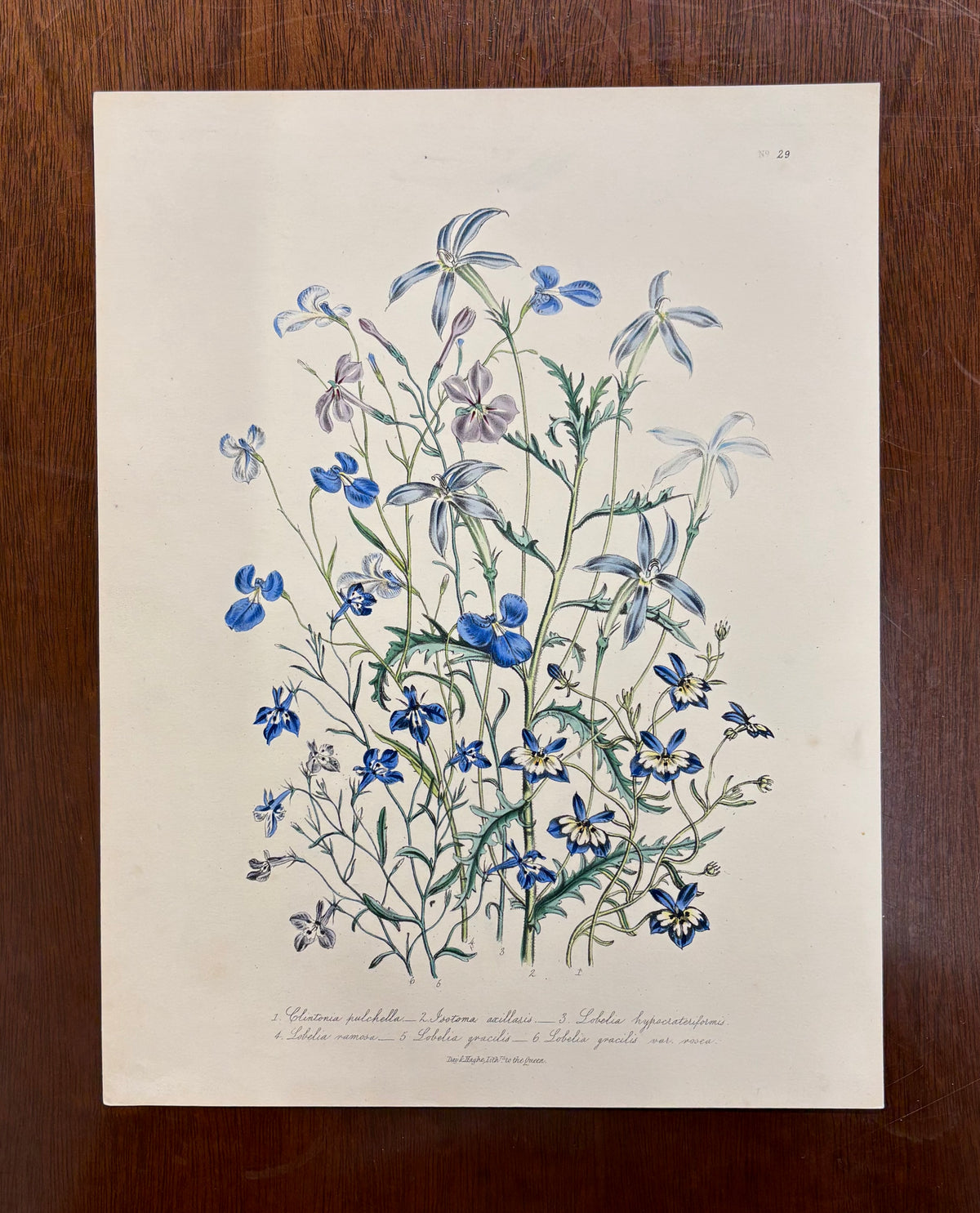
Pl. 29 by Jane Webb Loudon
Pl. 29 by Jane Webb Loudon
Couldn't load pickup availability
Pl. 29 by Jane Webb Loudon
C. 1848
Hand Colored Lithograph
Created by Jane Webb Loudon, this hand-colored lithograph, designated as Pl. 29 from The Ladies' Flower-Garden of Ornamental Annuals, illustrates a delicate bouquet of Clintonia, Isotoma, and Lobelia species. The print highlights Clintonia pulchella, Isotoma axillaris, Lobelia hypocrateriformis, Lobelia ramosa, Lobelia gracilis, and Lobelia gracilisvar. rosea, capturing their asymmetrical petals and starry blossoms in shades of cerulean, violet, and soft lavender. In Victorian floriography, Lobelia symbolized malevolence or distinction, while star-shaped wildflowers like Isotoma conveyed messages of quiet admiration and elegance. The composition features slender, branching stems and fine foliage interspersed with small white-and-yellow centered flowers, all articulated through sharp lithographic linework and soft watercolor tinting.
Created by Jane Webb Loudon (1807–1858), a pioneering English author and botanical illustrator, this plate exemplifies the 19th-century movement to demystify natural science for everyday audiences. Orphaned as a teenager, Loudon initially gained fame with her groundbreaking 1827 science fiction novel The Mummy!, before turning her sharp intellect to botany alongside her husband, landscape architect John Loudon. Through The Ladies' Flower-Garden, Loudon popularized colorful chromolithography and visual guides tailored specifically for women who were historically excluded from formal scientific institutions. Her work is historically significant because it transformed complex scientific instruction into accessible, elegant art, offering Victorian women both a tool for self-education and a medium for coded emotional communication through the popular language of flowers (floriography).
Dimensions: H 11”x 8 ½”W
Condition: Slight foxing