ANTONIO RAIMO GALLERY
Plate II in the Atlas Designed to Illustrate Burritt’s Geography of the Heavens, by Elijah Hinsdale Burritt
Plate II in the Atlas Designed to Illustrate Burritt’s Geography of the Heavens, by Elijah Hinsdale Burritt
Couldn't load pickup availability
Plate II in the Atlas Designed to Illustrate Burritt’s Geography of the Heavens, by Elijah Hinsdale Burritt
C.1835
Hand Colored Engraving
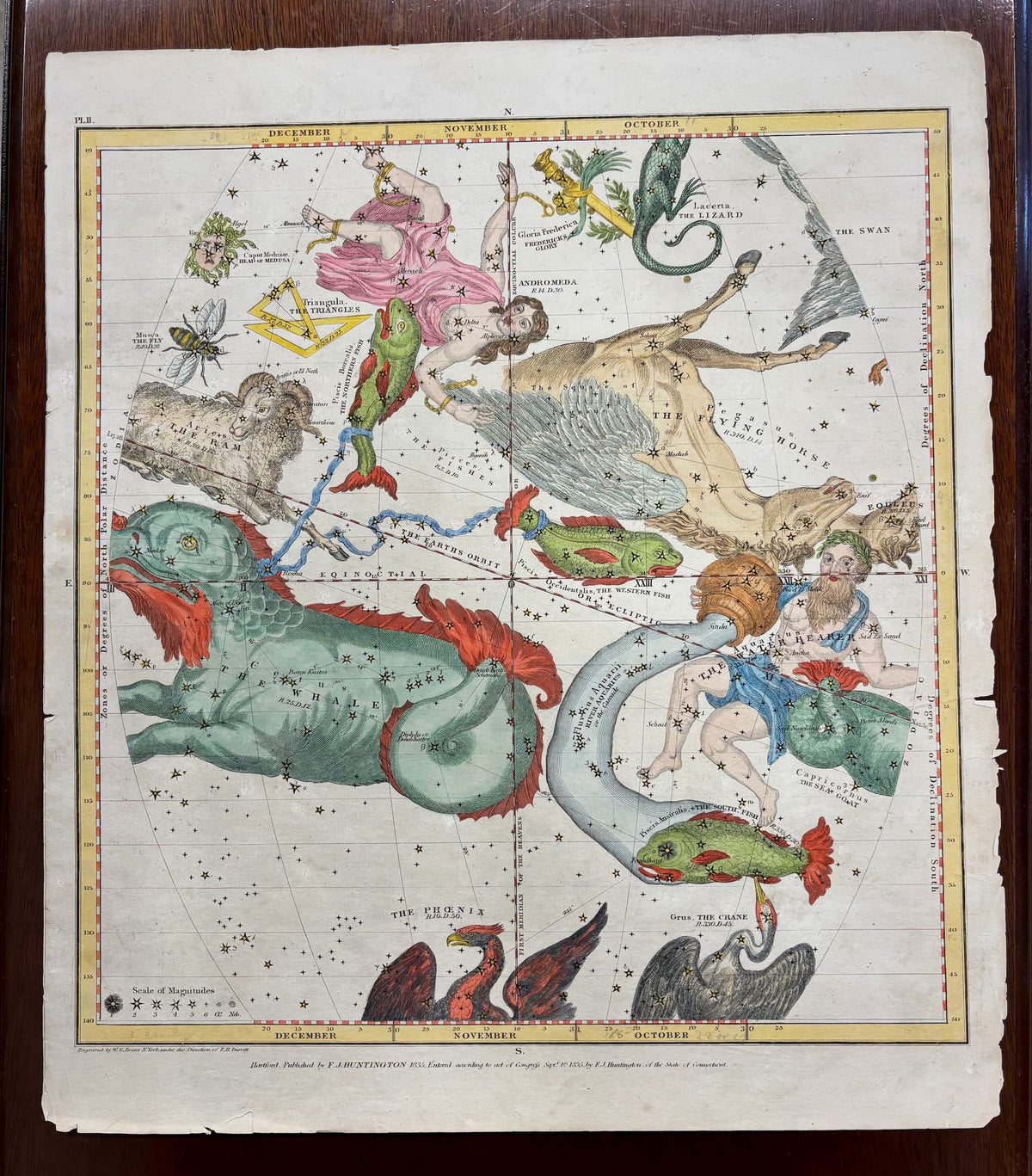
Dominating this 1835 hand-colored engraving ("Plate II") is a beautifully crowded composition of mythological beasts and allegorical figures, meticulously rendered for Elijah Hinsdale Burritt's Atlas Designed to Illustrate the Geography of the Heavens. Artistically, the print balances the fine, crisp line work of New York engraver W. G. Evans with soft, translucent watercolor washes that bring a striking vitality to the late-autumn and winter skies. The visual focal points include the massive, green-scaled form of Cetus (The Whale) rising from the lower left, the dramatic chained figure of Andromeda, and the majestic winged silhouette of Pegasus (The Flying Horse). Every figure is delicately shaded to create a sense of dimension against the flat coordinate grid, while the contrasting reds, greens, and pinks immediately draw the eye across the celestial canvas, serving as both a scientific tool and a masterpiece of early American decorative art.
First issued in Hartford in 1833, Burritt’s atlas was created as a highly accessible educational tool to accompany his textbook, The Geography of the Heavens. Elijah Hinsdale Burritt (1794–1838) was an American mathematician and astronomer nicknamed the "Blacksmith Astronomer" due to his early mechanical apprenticeship. He structured these specific charts based heavily on the artistic layout style of the 17th-century French Jesuit scientist Ignace-Gaston Pardies, heavily modernizing the coordinate scales for contemporary classroom use. This chart is incredibly important to cartographic history because it represents the first major, mass-produced celestial atlas created specifically for American schools. Prior to Burritt's publication, astronomy instruction relied heavily on foreign imports; his work democratized stargazing for hundreds of thousands of students and laid the foundation for popular astronomy education in the United States.
Dimensions: H 16” X 14” W
Condition: tears on side, toned with age, silver paint splatter and tape on back