ANTONIO RAIMO GALLERY
Plate IV in the Atlas Designed to Illustrate Burritt’s Geography of the Heavens, by Elijah Hinsdale Burritt
Plate IV in the Atlas Designed to Illustrate Burritt’s Geography of the Heavens, by Elijah Hinsdale Burritt
Couldn't load pickup availability
Plate IV in the Atlas Designed to Illustrate Burritt’s Geography of the Heavens, by Elijah Hinsdale Burritt
C.1835
Hand Colored Engraving
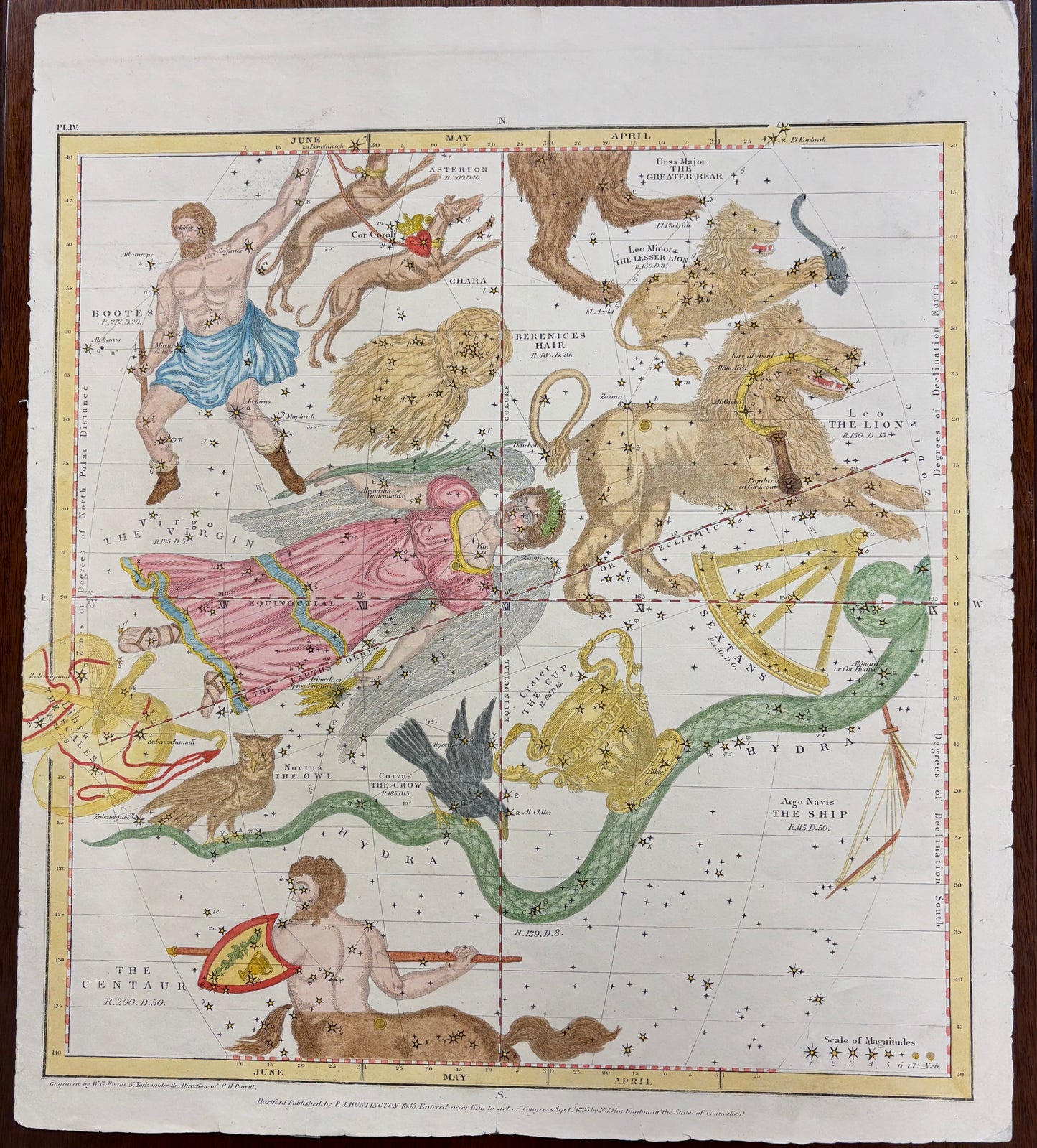
This hand-colored engraving, designated "Plate IV," is a detailed celestial chart published in 1835 by F. J. Huntington in Hartford, Connecticut, for Elijah Hinsdale Burritt's Atlas Designed to Illustrate the Geography of the Heavens. The map illustrates the spring and early summer night sky, highlighting prominent constellations such as Virgo (The Virgin), Leo (The Lion), Bootes (The Herdsman), and the sprawling form of Hydra (The Water Serpent). Richly decorated with vibrant allegorical figures overlapping a precise celestial grid, the print tracks right ascension, declination, and the path of the ecliptic corresponding to the ideal observation months of April, May, and June. As indicated by the lower margin inscription, the map was "Engraved by W. G. Evans, N. York, under the Direction of E. H. Burritt," capturing the intricate craftsmanship of early 19th-century American scientific illustration.
First issued in Hartford in 1833, Burritt’s atlas was created as a highly accessible educational tool to accompany his textbook, The Geography of the Heavens. Elijah Hinsdale Burritt (1794–1838) was an American mathematician and astronomer nicknamed the "Blacksmith Astronomer" due to his early mechanical apprenticeship. He structured these specific charts based heavily on the artistic layout style of the 17th-century French Jesuit scientist Ignace-Gaston Pardies, heavily modernizing the coordinate scales for contemporary classroom use. This chart is incredibly important to cartographic history because it represents the first major, mass-produced celestial atlas created specifically for American schools. Prior to Burritt's publication, astronomy instruction relied heavily on foreign imports; his work democratized stargazing for hundreds of thousands of students and laid the foundation for popular astronomy education in the United States.
Dimensions: H 16” X 14” W
Condition: Slightly toned with age, small tears on the sides