ANTONIO RAIMO GALLERY
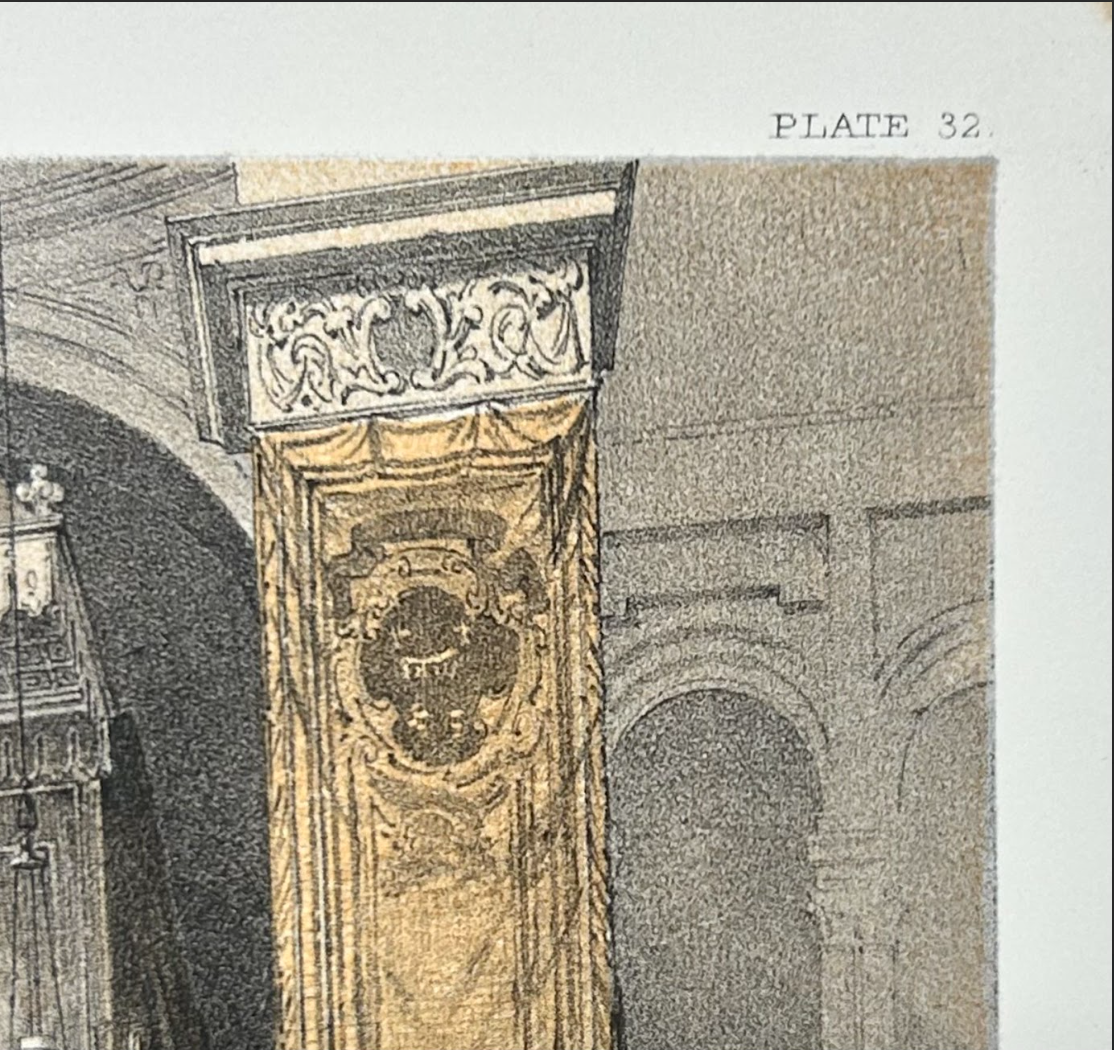
Hand Colored Engraving by Roberts, Church of the Annunciation, Nazareth, Plate 32
Hand Colored Engraving by Roberts, Church of the Annunciation, Nazareth, Plate 32
Couldn't load pickup availability
David Roberts (1796 - 1864)
Church of the Annunciation, Nazareth
Published 1855
Hand-colored Lithograph
This lithograph, Church of the Annunciation, Nazareth, was published between 1842 and 1849 as part of the six-volume work The Holy Land, Syria, Idumea, Arabia, Egypt & Nubia, issued in London by F.G. Moon. Based on drawings and watercolors by Scottish artist David Roberts and lithographed by Louis Haghe. Here the interior of the Church of the Annunciation in Nazareth is rendered with meticulous attention to architectural detail, presenting a solemn, ordered sacred space animated by a few quietly moving monastic figures. According to Christian tradition, this is the site where the Archangel Gabriel appeared to Mary and announced that she would bear the Son of God, an event underscoring the church’s foundational theological significance. The Latin inscription above the triple-doorway, drawn from the Gospel of John, “The Word was made flesh, and dwelt among us,” further anchors the space as both doctrinal statement and visual proclamation. Roberts frames the interior with a Romantic sensibility that emphasizes grandeur, serenity, and spiritual authority, shaping the Holy Land for a nineteenth-century European audience eager for both devotional resonance and exoticized antiquity while simplifying the complex lived realities of the region.
The work was produced from Roberts’s extensive travels through Egypt, the Holy Land, Petra, Sinai, Syria, and Nubia between 1838 and 1839, undertaken during a period of heightened European fascination with biblical archaeology and the ancient Near East. Originally trained as a theatrical scene painter, Roberts translated his understanding of dramatic staging into sweeping, highly composed landscapes that balanced visual spectacle with careful attention to topography, architecture, and local costume. The resulting series became one of the most influential visual records of the region in the Victorian period, shaping European perceptions of sites such as Gaza and Jerusalem long before systematic archaeological excavation. Widely acclaimed at the time as a landmark of print culture and praised for its technical sophistication, the publication is often regarded as one of the most ambitious lithographic projects of the nineteenth century and remains significant both as an artistic achievement and as a historical document of the eastern Mediterranean prior to modern transformation.
Dimensions: H 11 1/4" x 8" W
Condition: Some foxing on edges, tape on back