ANTONIO RAIMO GALLERY
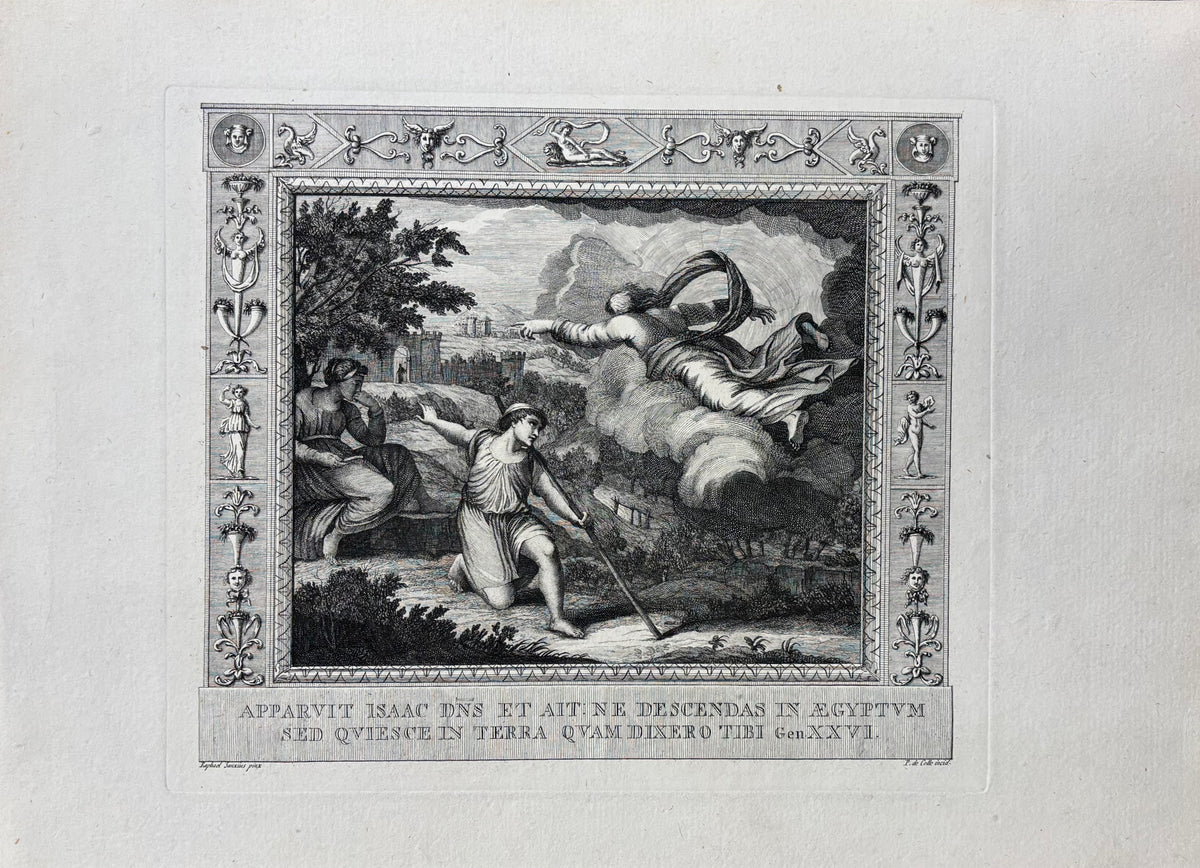
"The Lord Appeared to Isaac" by Raphael
"The Lord Appeared to Isaac" by Raphael
Couldn't load pickup availability
The Lord Appeared to Isaac by Raphael
c.1742
Engraving
The dramatic Old Testament narrative "The Lord Appeared to Isaac" is brought to life in this 18th-century black-and-white copperplate engraving, which replicates a celebrated masterpiece designed by the High Renaissance giant Raphael. The central composition illustrates the dynamic, flying figure of God emerging from billowing celestial clouds to command Isaac not to flee into Egypt but to remain in the promised land. Below the heavenly vision, a youthful Isaac kneels on one knee while leaning on a staff, looking backward toward his wife Rebekah who sits thoughtfully resting her chin in her hand beneath a shaded tree. A wide, highly ornate border frames the entire narrative scene, heavily decorated with repeating classical grotteschi motifs including winged cherub heads, sirens, floral urns, and mythological hybrid creatures. The Latin inscription along the lower margin quotes Genesis 26, reading "APPARUIT ISAAC DNS ET AIT NE DESCENDAS IN AEGYPTUM SED QUIESCE IN TERRA QUAM DIXERO TIBI Gen. XXVI." The lower margins attribute the original composition to Raphael on the left ("Raphael Sanctius pinx.") and the plate engraving to the Italian printmaker Francesco de Grado on the right ("F. de Grado incid.").
This engraving reflects the profound 18th-century European fascination with classical antiquity and the visual reconstruction of ancient literary figures. Created during a period when aristocratic collectors and scholars eagerly built expansive libraries of historical prints, this work showcases the sophisticated collaborative printmaking networks of Italy. Artists like Francesco de Grado specialized in translating classical narratives into accessible, highly detailed two-dimensional portraits that blended historical armor studies with allegorical landscapes. Prints like this hold significant historical importance because they served a dual purpose, functioning both as high-status decorative art for grand European estates and as vital academic reference tools used by Enlightenment-era scholars to study classical mythology, literature, and design.
Dimensions: H 13” x 17 ½” W
Condition: Tape on back